
Last updated: 4 November 2026
OSH Code 2020 state rules are being notified one state at a time, so what you must comply with depends on where your plant is located. This living tracker shows which states have final rules, what the Central OSH Rules, 2026 changed, and what fire and safety teams should check.
Status in one line: The OSH Code has been in force since 21 November 2025, the Central OSH Rules were notified on 8 May 2026, and state rules are being notified one state at a time. Until your state’s rules are final, older rules continue under the Code’s savings provisions.
This is a living post. We update this page as states notify their rules, instead of publishing a new post each time. See the change log at the end.
Key Takeaways
- The Occupational Safety, Health and Working Conditions (OSH) Code, 2020 is the umbrella law. It replaced 13 central labour laws, including the Factories Act, 1948.
- Day-to-day compliance depends on rules: the Central Rules for central-sphere establishments and state OSH Rules for most factories.
- State progress is uneven. Gujarat, Rajasthan, Andhra Pradesh and Uttar Pradesh have final OSH Rules. Maharashtra is still at draft stage. Karnataka’s final status is not confirmed.
- The Code and rules set the legal duty. Fire system design values still come from standards such as NBC 2016 Part 4 and OISD.
Table of Contents
What Is the OSH Code 2020?
The OSH Code merges the laws on workplace safety, health and working conditions into one framework. It replaced these 13 central Acts:
- Factories Act, 1948
- Mines Act, 1952
- Building and Other Construction Workers Act, 1996
- Contract Labour (Regulation and Abolition) Act, 1970
- Inter-State Migrant Workmen Act, 1979
- Plantations Labour Act, 1951
- Dock Workers (Safety, Health and Welfare) Act, 1986
- Motor Transport Workers Act, 1961
- Beedi and Cigar Workers Act, 1966
- Cine Workers and Cinema Theatre Workers Act, 1981
- Sales Promotion Employees Act, 1976
- Working Journalists Act, 1955
- Working Journalists (Fixation of Rates of Wages) Act, 1958
Why State Rules Still Matter
Labour is a concurrent subject, so the Code works through “appropriate government” rules. For example, the Central Government is the appropriate government for mines, while the State is the appropriate government for most factories. Registration, licensing, reporting timelines and many local procedures are therefore set by the OSH Code 2020 state rules
Where a state has not yet notified final rules, the Code’s savings provisions keep earlier rules working to the extent they do not conflict with the Code. Confirm the transition position with your state labour or factories department.
Timeline
| Date | Event |
|---|---|
| September 2020 | Code passed by Parliament |
| 21 November 2025 | Code comes into force |
| 30 December 2025 | Draft Central Rules published |
| 8 May 2026 | Final Central OSH Rules notified (G.S.R. 345(E)) |
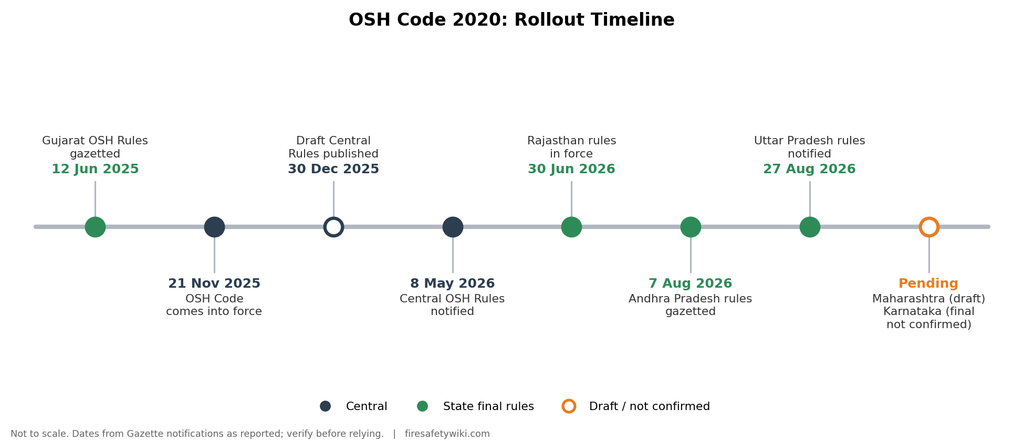
OSH Code 2020 State Rules Tracker (as of 4 November 2026)
| State | Status | Reference | What to note |
|---|---|---|---|
| Gujarat | Final | Gujarat OSH Rules, 2025 (No. GR/2025/76/FAC/142021/68396/M3; Gazette Extra No. 87, 12 June 2025) | Replaces the Gujarat Factories Rules, 1963 and other legacy state rules. Fatal accidents must be notified within 12 hours. |
| Rajasthan | Final | OSH Rules, 2026 (S.O. 23), in force 30 June 2026 | Covers registration, licensing, hazardous processes and MAH installations. |
| Andhra Pradesh | Final | G.O.Rt.No. 146, gazetted 7 August 2026 | Supersedes eight earlier state labour enactments. |
| Uttar Pradesh | Final | Notification No. 962/XXXVI-03-2026-1903305, 27 August 2026 | Applies to factories, construction and other establishments. |
| Karnataka | Draft published, final not confirmed | Revised draft, 23 January 2026 | Sources conflict. Check the Karnataka Gazette before relying on either position. |
| Maharashtra | Draft | Draft OSH (Factories and Other Ports) Rules and OSH (Labour) Rules, 2026 | Still in draft as of early October 2026. Existing rules continue until final notification. |
Other states are at various stages. We add a row only after verifying it from the Gazette.
Safety Officers and Safety Committees: What the Code Actually Says
Section 22 has two parts, and they are often confused:
- Safety Officers (§22(2)): Required in a factory with 500 or more workers, a factory with a hazardous process and 250 or more workers, building or construction work with 250 or more workers, and a mine with 100 or more workers.
- Safety Committee (§22(1)): Set by the appropriate government’s order and rules. Commentary on the Central Rules reports a threshold of 500 or more workers, and the Maharashtra draft proposes lower thresholds. Check the rules that apply to your establishment.
- Read more: Safety Officer vs Safety Committee
Which rules apply to you? The Central Rules apply where the Central Government is the appropriate Government. For most factories the State Government is, so your state’s OSH rules apply. Until a state notifies final rules, earlier state rules continue only as the Code’s savings provisions allow.
What This Means for Fire and Safety Teams
- Identify your appropriate government. This tells you whether the Central Rules or a state’s rules apply to your site.
- Read your state rules for reporting. Gujarat’s 12-hour fatal accident notice shows how timelines can differ from the old regime.
- Update incident reporting procedures. The Central Rules list dangerous occurrences that include fire, explosion and hazardous gas leakage. Align your internal incident classification with these statutory triggers.
- Keep using technical standards for design. The Code does not set fire water storage duration or similar design values. These come from standards such as NBC 2016 Part 4, OISD standards and your own design basis.
- Check licences and appointments. Existing ones are generally preserved by savings provisions, but renewal and transition procedures vary by state.
Our View
In any change of legal framework, the practical risk is working from the old rulebook by habit. Name one person to track your state’s rules, review your registers and reporting forms against them, and record the date you checked.
Frequently Asked Questions
Is the OSH Code in force?
Yes, since 21 November 2025. Some operational detail depends on rules that are still being notified.
Has the Factories Act, 1948 been repealed?
Yes. The OSH Code replaced it, along with 12 other central Acts.
Which rules apply to my factory?
Usually your state’s OSH Rules. Where final state rules are not yet notified, the savings provisions continue earlier rules to the extent they do not conflict with the Code.
Does the OSH Code set fire water storage requirements?
No. Design values come from standards such as NBC 2016 Part 4 and OISD standards, plus any state requirements.
Where can I check for changes?
In the official Gazette of your state and the Ministry of Labour and Employment, and on this page, which we update.
Change Log
- 4 November 2026: First version. Added Central OSH Rules (8 May 2026) and status for Gujarat, Rajasthan, Andhra Pradesh, Uttar Pradesh, Karnataka and Maharashtra.
Sources
- PIB factsheet on the OSH Code, 2020: https://www.pib.gov.in/FactsheetDetails.aspx?Id=150475
- OSH (Central) Rules, 2026, Gazette of India: https://egazette.gov.in/writeReadData/2026/272379.pdf
- Gujarat OSH Rules, 2025, Gujarat Gazette: https://egazette.gujarat.gov.in/ViewPdf2.aspx?docid=202506211116370786.pdf&cdbid=b0e64ed7cf82a14d601957c2d02cc037&contentType=application/pdf
- Maharashtra Labour Department, draft rules: https://labour.maharashtra.gov.in/en/publication/new-labour-code
Rajasthan, Andhra Pradesh and Uttar Pradesh references are taken from their state gazette notifications as reported by law-firm and compliance trackers. Verify against the Gazette before relying on them.
This page is general information, not legal advice. Always confirm requirements in the official Gazette and with your state labour or factories department.
Pingback: Safety Officer vs Safety Committee: OSH Code Section 22
Pingback: AZF Toulouse Explosion 2001: Causes and Lessons
Pingback: What is Fire Safety? Guide for Industrial Facilities