
What is fire safety? Fire safety is the set of practices, systems, and rules designed to prevent fires, limit their spread, protect people, and reduce damage when a fire does occur. It covers everything from how a facility is designed to how workers are trained and how quickly an emergency team can respond.
In industrial facilities such as chemical plants, refineries, and fertilizer complexes, fire safety carries higher stakes. Flammable liquids, gases, high temperatures, and electrical loads mean a small incident can escalate quickly. This guide explains the core ideas in plain language.
Contents
How Fire Works: The Fire Triangle
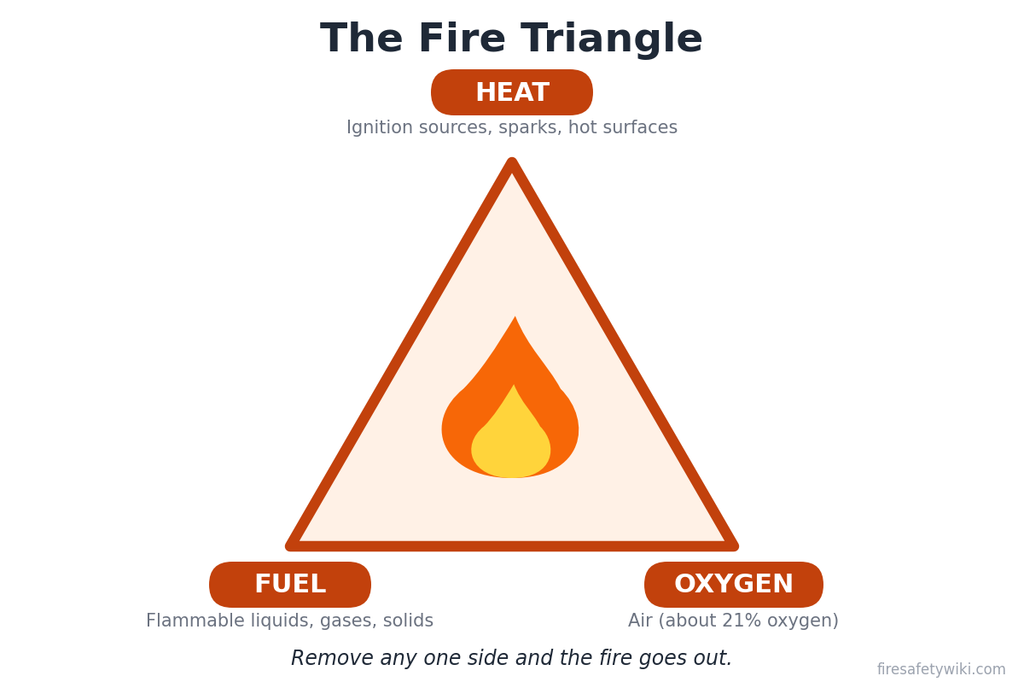
Every fire needs three things: heat, fuel, and oxygen. This is known as the fire triangle. Remove any one of them and the fire goes out. Almost every fire safety measure, from keeping flammable materials apart to applying water or foam, works by breaking one side of this triangle.
The Four Pillars of Fire Safety
- Prevention: Stopping fires from starting. This includes controlling ignition sources, safe storage of flammable materials, hot work permits, housekeeping, and regular inspections.
- Detection and Alarm: Finding a fire early. Smoke, heat, and flame detectors, gas detectors, and manual call points raise the alarm before a fire grows.
- Protection and Suppression: Controlling the fire. This includes extinguishers, hydrants, sprinklers, foam systems, and a deluge system for high-hazard areas, all supplied by a reliable fire pump and water network.
- Emergency Response and Training: People and procedures. Trained fire crews, evacuation plans, mock drills, and clear roles decide how well a plant handles a real emergency. For a closer look at the water supply behind these systems, see Fire Pump Sizing: How to Calculate Power Requirements.
Over more than 25 years in fire and loss prevention, from Trainee Fire Officer to Administrative Head of Fire & Safety at a major Indian chemical company, I have found that the basics are the most underestimated part of fire safety. Serious industrial incidents rarely start with rare technical failures. They usually trace back to ordinary lapses: poor separation between storage and process areas, uncontrolled hot work, tolerated leaks, weak housekeeping, neglected detection systems, and changes made without a proper hazard review. Equipment alone does not keep a plant safe. Discipline in these basics does.
Classes of Fire
Different fuels need different extinguishing methods:
- Class A: Ordinary combustibles such as wood, paper, and cloth
- Class B: Flammable liquids such as petrol, solvents, and oils
- Class C: Flammable gases
- Class D: Combustible metals
- Electrical fires: Fires involving live equipment, which need non-conductive agents
- Cooking oil fires: Called Class K in the US and Class F in Europe
Using the wrong agent can make a fire worse, which is why identifying the fire class matters.
Standards and Regulations
Fire safety is guided by codes and laws. Commonly referenced ones include NFPA standards (widely used worldwide), OISD standards for the oil and gas sector in India, the National Building Code of India (Part 4: Fire and Life Safety), and provisions on fire precautions under the Factories Act, 1948. Which ones apply depends on the type of facility and where it is located.
In my experience, fire safety begins at the design stage of an industrial facility, and standards work best as tools for risk engineering rather than rigid checklists. During an upgrade at a chemical facility, space constraints made the prescribed separation distances between high-hazard process units and storage areas hard to achieve. We benchmarked the layout against OISD-STD-118 and NFPA 30, carried out a detailed consequence analysis, and justified an equivalent level of safety through engineered mitigations: medium-velocity water spray (MVWS) deluge systems, a rapid gas detection network, and passive fire protection. This secured both technical and regulatory approval.
What Is Fire Safety in Industrial Facilities?
- Larger inventories of flammable and toxic materials
- Fire water systems that must run reliably for hours
- Need for incident classification and reporting
- Greater dependence on trained, on-site emergency teams
The honest lesson from decades in high-hazard operations is that few plants consciously decide to accept more risk. Instead, inventory creeps upward, an extra tank here, a fuller warehouse there, while firewater supply, separation distances, housekeeping, and detection stay fixed at what was acceptable years earlier.
The hazard of a larger inventory is rarely just the quantity itself. It is the unmitigated gap between that quantity and the protection that was never upgraded to match it. That gap strains the firewater supply, overburdens emergency teams, and can push a potential incident beyond what existing reporting and response procedures were designed for. For how the design fire scenario is set under OISD and IS 13039, see Fire Water Demand in India: OISD vs IS 13039.
Too often, safety is still treated as a legal obligation to be satisfied rather than an engineering discipline that protects life and assets.
Key Takeaways
- Fire needs heat, fuel, and oxygen; remove one and it stops
- Good fire safety rests on prevention, detection, protection, and response
- The right extinguishing agent depends on the fire class
- Standards set the minimum; real safety depends on design, maintenance, and training
Conclusion
Fire safety is not a one-time installation. It is a system that must be designed, maintained, tested, and practised continuously. This site will cover each part in detail, including standards, equipment, and incident analysis.
Related Articles
- Ammonia Leak Mitigation: Using Water Spray and Water Curtains Safely
- Hot Work Safety: Hidden Fire Hazards and Permit Controls
- API RP 754: Process Safety Incident Classification (Tier 1 to 4)
- OSH Code 2020 and State OSH Rules: Live Regulatory Tracker for Fire and Safety Teams
- Water-Based Fire Protection Systems in Industrial Facilities: MVWS, HVWS, Sprinkler, Deluge, Drencher and Water Curtain
- Passive Fire Protection (PFP) in High-Hazard Industrial Facilities: A Practical Engineering Guide
Pingback: Fire Pump Sizing: How to Calculate Power Requirements
Pingback: API RP 754: Process Safety Incident Classification (Tier 1 to 4)
Pingback: What Is Passive Fire Protection? Industrial PFP Guide
Pingback: Hot Work Safety: Hidden Fire Hazards and Permit Controls
Pingback: Fire Water Demand in India: OISD vs IS 13039